The question is fair. You have a document that claims to be the word of God, copied by hand for centuries, translated into hundreds of languages, edited by committees, and controlled at various points by institutions with obvious interests in the outcome. If you were designing a system to corrupt a text, that’s roughly the system you’d design.
So the question isn’t whether to ask it. The question is whether the evidence holds up when you actually look.
It does. Not because Christians say so. Because the manuscript record says so.
The Objections Worth Taking Seriously
Before making the case, here are the four objections that deserve honest engagement. These aren’t strawmen. They’re what thoughtful people actually say.
1. The Telephone Game
The Bible was copied by hand, thousands of times, over hundreds of years. Every copy introduced potential errors. Errors built on errors. By the time you get to a modern Bible, you’re reading the result of a centuries-long game of telephone. Everyone knows how that ends.
2. The Council of Nicaea Decided What the Bible Is
The Bible we have isn’t the original collection of Christian writings. It’s the version the institutional Church selected in 325 AD. Books that didn’t fit the political agenda were cut. What survived wasn’t the most authentic material; it was the most useful material for the people in power.
3. The Time Gap Makes It Unknowable
Our earliest complete manuscripts are centuries removed from the original writings. We have no originals. We have copies of copies of copies. The gap between when something was written and when we can verify it gives too much room for change to be confident about what the originals actually said.
4. Translation Corruption
The Bible has been translated and retranslated so many times, from Hebrew and Greek into Latin, then into German and English and hundreds of other languages, that the version you’re reading today bears little resemblance to the original text. Something is always lost in translation. Over enough iterations, what’s lost is everything.
Why Each Objection Doesn’t Hold
The telephone game misunderstands how manuscripts work
The telephone game produces drift because there’s only one line of transmission. Each person hears from one person and passes it to one person. Errors compound with no correction mechanism.
That’s not how ancient manuscripts worked. New Testament manuscripts weren’t copied in a single chain. They were copied in parallel, across different geographic regions: North Africa, Rome, Syria, Asia Minor. Communities that had no contact with each other. When you compare manuscripts from these independent streams and they align, you have cross-verification that no single chain of copies can provide.
Textual critics, the scholars whose job is finding exactly these variations, have identified roughly 400,000 variants across New Testament manuscripts. That number sounds alarming until you understand what it means.
Start with what counts as a variant. The same spelling error appearing across fifty copies is counted fifty times. A single word with a different ending in one manuscript is a variant. Word order differences that don’t change meaning are variants. The vast majority are that trivial.
Textual scholars Brooke Westcott and Fenton Hort, who produced one of the most influential critical editions of the Greek New Testament, estimated that only 1 in 60 variants has any real significance. That leaves the text 98.33% pure across all copies. Church historian Philip Schaff pushed further: of the 150,000 variants known in his day, only 400 changed the meaning of a passage, only 50 were of real significance, and not even one affected a single article of Christian faith or a precept of duty that isn’t abundantly supported elsewhere in Scripture.
Bart Ehrman, a former evangelical who became one of Christianity’s sharpest academic critics, concedes the same point from the skeptic’s side: the variants affecting any doctrinally significant claim are a small fraction of the total, and none alter a core Christian teaching.
When a critic and a defender of the text reach the same conclusion independently, that’s not faith. That’s evidence.
The Council of Nicaea is a persistent myth
The Council of Nicaea in 325 AD addressed the theological question of Christ’s divine nature. It did not assemble, vote on, or canonize the New Testament. This is a popular claim that does not survive contact with the historical record.
The New Testament canon formed gradually and organically, through a process of use. Churches across the Roman world identified which writings carried apostolic authority by how consistently they were cited, read in worship, and treated as authoritative. Most of the books that ended up in the New Testament were in wide circulation and treated as Scripture well before Nicaea. Paul’s letters were being quoted as Scripture by the early second century, within decades of when they were written.
The “winners wrote the history” framing assumes the institutional Church had both the motive and the mechanism to scrub inconvenient texts. The evidence points in the opposite direction: early church fathers quoted extensively from texts that didn’t make the canon, debated inclusions openly, and the process was messier and more distributed than any coordinated suppression campaign could have managed.
The time gap is smaller than for any comparable ancient document
No historian refuses to trust Julius Caesar’s account of the Gallic Wars because the earliest surviving manuscript is from 900 years after he wrote it. No classicist dismisses Tacitus because the gap between composition and our earliest copy is over 1,000 years. These are the normal conditions of ancient documents, and historians work with them routinely.
The New Testament is, by every standard measure, the most well-attested document from the ancient world. The numbers make the gap visible:
| Document | Surviving Copies | Earliest Manuscript |
|---|---|---|
| Caesar’s Gallic Wars | 10 | ~1,000 years after original |
| Plato’s Works | 7 | ~1,200 years after original |
| Homer’s Iliad | ~643 | ~500 years after original |
| New Testament | 5,800+ Greek; 10,000+ other languages | Decades after original (P52, c. 125 AD) |
These figures come from Turek and Geisler’s I Don’t Have Enough Faith to Be an Atheist, which draws on standard reference data used by textual scholars. The point isn’t that the New Testament is special because Christians say so. It’s that by the criteria historians actually apply to ancient documents, it outperforms every comparable text by orders of magnitude.
The standard applied to the New Testament, if applied consistently to any other ancient document, would empty the classical section of every library in the world.
Translation corruption is not how translation works
Modern Bible translations don’t derive from earlier translations. They go back to the original Hebrew and Greek manuscripts. When scholars produced the English Standard Version or the NIV, they weren’t translating the King James Bible. They were working directly from the earliest available manuscript sources, using the best tools of contemporary textual criticism.
The translation process is also not opaque. Major translations publish their methodologies, identify their source texts, and the decisions made in the translation process are documented and debated publicly. This isn’t a black box. It’s one of the most scrutinized translation projects in human history.
Errors in translation are real and worth examining in specific cases. The claim that cumulative translation has made the modern Bible unrecognizable to the original text is not supported by comparing modern translations against the manuscript sources.
What the Evidence Actually Shows
The New Testament is not transmitted to us by faith. It’s transmitted by evidence: more evidence, by every standard measure, than any other document from the ancient world.
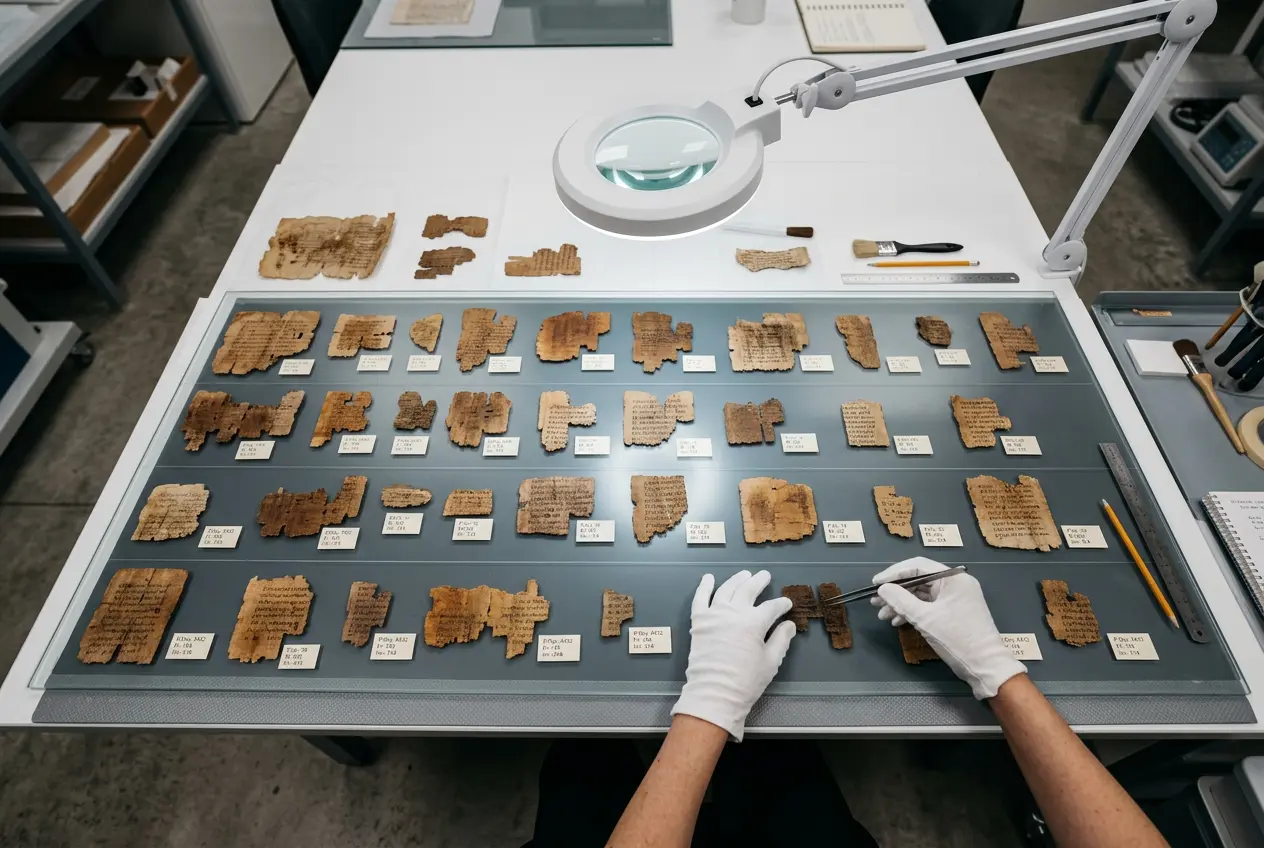
Here’s what that evidence looks like on the ground.
This matters because it gives textual critics an enormous pool of cross-verification. When a variant appears in one manuscript tradition, scholars can check it against independent streams. The overwhelming consistency of the manuscript tradition, across geography, time, and language, is precisely what gives scholars confidence that what we have reflects what was originally written.
Textual scholar Bruce Metzger put a number on what that cross-verification produces. Citing his work in I Don’t Have Enough Faith to Be an Atheist, Turek and Geisler note that Metzger estimated the Mahabharata, the sacred Hindu epic, is transmitted with roughly 90% accuracy across its copies. Homer’s Iliad, with its 643 manuscripts, comes in at about 95%. The New Testament, with its thousands of manuscripts across independent geographic streams, is transmitted with approximately 99.5% accuracy. That remaining 0.5% does not affect a single doctrine of the Christian faith.
Lee Strobel, a former legal journalist and self-described atheist who spent years investigating these questions, documented his interviews with leading New Testament scholars in The Case for Christ. The consistent answer he received was that the New Testament text is more reliably transmitted than any other ancient document, and that no essential Christian claim rests on a disputed textual variant.
Frank Turek puts the double-standard directly: the skeptical criteria applied to the New Testament, if applied consistently to Caesar, Plato, or Aristotle, would require abandoning nearly everything we think we know about the ancient world. The New Testament isn’t held to a higher standard because the evidence is weaker. It’s held to a higher standard because the claims are harder to accept.
Norman Geisler, who spent decades on the question of biblical reliability, argued that the manuscript evidence is not just adequate. It’s overwhelming by any standard used in ancient historiography. The question is not whether we can know what the original authors wrote. The question is what we’re going to do with what they wrote.
This is where the manuscript question leads. The reliability of the text is not the last line of defense against a claim you’d rather not believe. It’s the first question. Once it’s settled, the harder question comes into view.
The New Testament documents were written by people who were either present at the events they describe or had direct access to eyewitnesses. They were written within the lifetime of people who could have contradicted them. They were copied with a fidelity that no comparable ancient document matches. And they make specific, falsifiable, historical claims. Most centrally: that a man named Jesus of Nazareth was executed under Pontius Pilate and was seen alive three days later by hundreds of witnesses.
That claim is either true or it isn’t. But it cannot be dismissed by saying the text has been corrupted. The text is one of the most stable ancient documents we possess.
The Question You’re Actually Left With
The corruption argument is the easier objection. If the text is unreliable, you never have to engage what it says. But the evidence doesn’t cooperate. The manuscript record is too large, too consistent, and too early to sustain the claim that we’ve lost what the original authors wrote.
Which means the actual question is harder: not whether the Bible has been changed, but whether what it says is true.
That question deserves the same honest examination you just gave this one.