
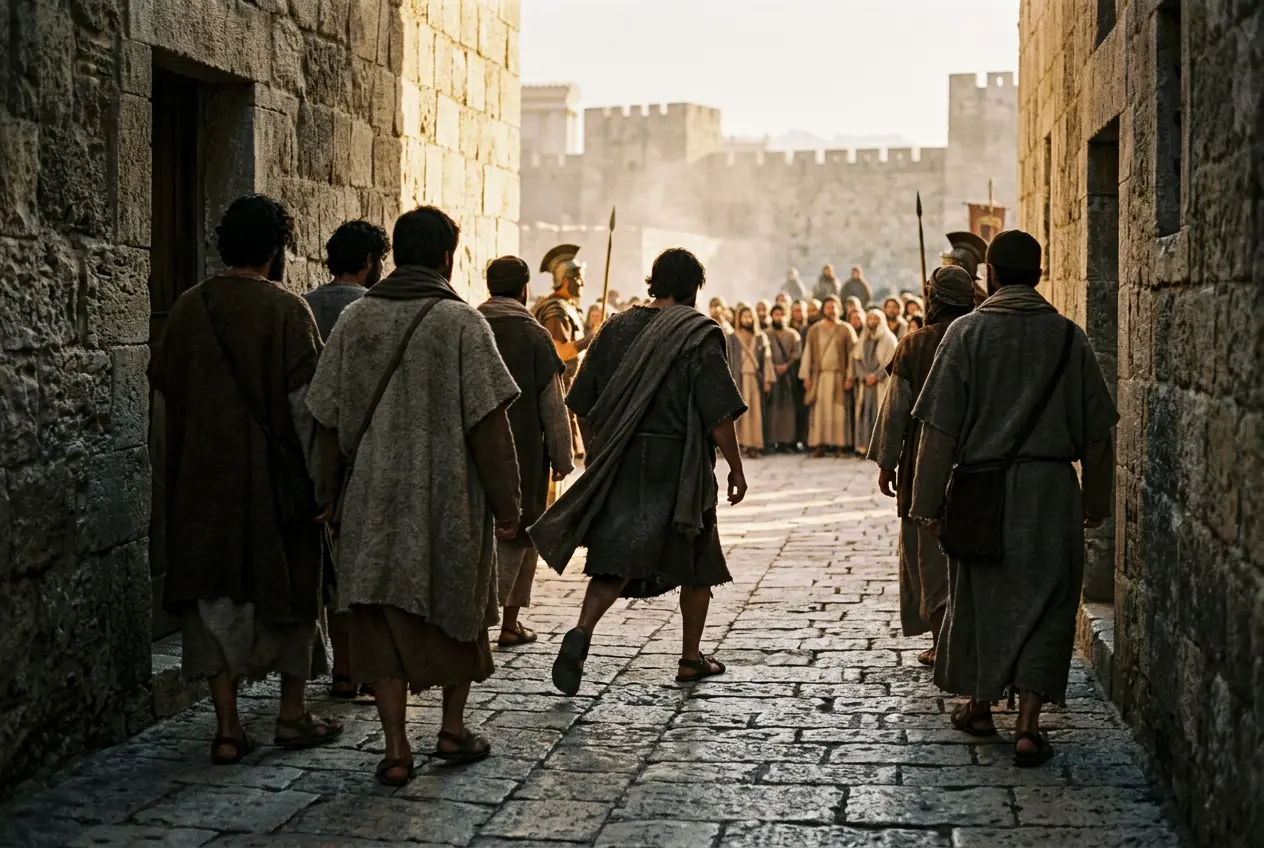
Most people who dismiss the resurrection have a ready answer for it: it’s a story. A comforting myth. Something a grieving community built around a leader they’d lost. That answer feels reasonable until you look at what it requires you to ignore.
Why did they die for it?
Not metaphorically. Not “they suffered social rejection” or “they faced hard times.” Peter was crucified upside down. James was beheaded. Andrew was crucified. Thomas, according to early sources, was run through with a spear in India. These were not men who drifted away from their convictions when things got uncomfortable. They held their position under the kind of pressure that has a way of separating what people actually believe from what they’ve simply said.
That fact sits at the center of the resurrection debate, and it’s the one that gets the least attention.
The Objections Worth Taking Seriously
Before making the case, four objections deserve honest treatment. They’re the ones a thinking skeptic would actually raise, and none of them are weak.
Objection 1: People die for false beliefs all the time.
Martyrdom doesn’t require truth. Suicide bombers die for beliefs that are almost certainly false. Heaven’s Gate members died for a belief in a spaceship behind a comet. Sincerity and accuracy are not the same thing, and history is full of people who died for something that wasn’t real.
Objection 2: We don’t actually know the disciples were martyred.
The historical record on the apostles’ deaths is incomplete. Some accounts come from sources written well after the fact. A skeptic has every right to ask whether we’re working from solid history or from tradition that hardened into assumed fact.
Objection 3: The disciples were deluded, not lying.
Maybe they genuinely believed they saw a risen Jesus. That doesn’t mean the resurrection happened. Grief does strange things. Mass psychology is real. They could have experienced visions, hallucinations, or wishful perception and then died for what they sincerely but incorrectly believed they saw.
Objection 4: The story evolved over decades. They died for a legend.
The gospels were written decades after the events they describe. Maybe the early disciples died for a simpler, vaguer faith, and the resurrection claim developed gradually until it became the central story. They wouldn’t have known they were dying for something that had grown beyond what actually happened.
Where Each Objection Breaks Down
On dying for false beliefs:
The comparison to other martyrs misses a critical distinction. People die for beliefs they cannot verify. A suicide bomber cannot know whether paradise awaits. A Heaven’s Gate member cannot know whether the spacecraft is real. They are betting on something they have no direct access to.
The disciples are a different category entirely. They weren’t dying for a theological proposition or a promise about the afterlife. They were dying for a specific, concrete, verifiable claim: that they had personally seen Jesus alive after his execution. That’s not a belief. That’s a testimony.
The question isn’t whether people die for false beliefs. They do. The question is whether people die for something they know to be a lie they invented. That’s a different thing, and the answer across every example in history is no. People recant. They bargain. They take the exit when the cost of the lie becomes their life.
On the weakness of the historical record:
The skeptic is right that some accounts of the apostles’ deaths come from later sources and deserve scrutiny. But the core of the case doesn’t depend on every tradition being ironclad.
What historians across the theological spectrum, including non-Christian scholars, do affirm is this: the early disciples proclaimed the resurrection publicly and suffered significantly for it. New Testament scholar and historian N.T. Wright, whose scholarly credentials are unimpeachable and whose work on the resurrection has not been successfully rebutted, notes that the rapid, aggressive spread of the resurrection claim in Jerusalem, the very city where the execution occurred within weeks of it, is historically unexplainable on any theory except that something happened. James, the brother of Jesus, is another anchor point. He was a skeptic during Jesus’s ministry (John 7:5). He became a leader of the Jerusalem church and was executed by the high priest Ananus in 62 AD, a death recorded by the Jewish historian Josephus, a non-Christian source.
What turned a skeptic into a martyr? Paul, who by his own account was actively persecuting Christians before his reversal, gives the same testimony: he saw Jesus alive (1 Corinthians 15:8). His execution under Nero is among the best-attested deaths in early Christian history.
You don’t need every tradition to hold for the case to stand.
On hallucination and delusion:
The hallucination theory is the most intellectually serious of the alternatives, and it deserves a direct answer.
Hallucinations are individual experiences. They do not occur in groups. A grief-induced vision might explain one person’s experience, or possibly a small number of related people under shared emotional strain. It does not explain what Paul records in 1 Corinthians 15:6: that Jesus appeared to more than 500 people at once, most of whom were still alive when Paul wrote and could be questioned. Paul is essentially saying: go ask them. That’s not the move of someone building a legend. That’s the move of someone confident the witnesses will corroborate the account.
But the witnesses who matter most for the martyrdom argument are not the 500. They are the inner circle, the ones who were present from the beginning, who saw what they saw, and who then faced the specific choice: recant or die. The hallucination theory requires every one of them to have been so gripped by a shared psychological episode that not one of them broke under torture and execution and said it wasn’t real. Mass hallucinations, under current psychological understanding, don’t produce consistent, coherent, interactive experiences across groups.
But even granting the possibility, a hallucination that holds under death is not a hallucination doing the work of a hallucination. It’s a conviction. And the question of what produced that conviction remains.
On dying for a legend:
This objection has a timing problem. The gap between the crucifixion and Paul’s letter to the Corinthians, which contains one of the earliest recorded summaries of the resurrection claim including the list of witnesses, is not decades. Scholars date 1 Corinthians to roughly 55 AD. The creed Paul cites within it (1 Corinthians 15:3-5) is older than the letter itself, with most historians placing its origin within a few years of the crucifixion. William Lane Craig, whose work on the resurrection has been engaged seriously by skeptical scholars, places the creed’s origin within two to five years of the events it describes.
This is not the timeline of legend formation. Legends require the absence of living witnesses and the passage of enough time for memory to be replaced by myth. The resurrection claim was made early, publicly, and in a city full of people who could have falsified it by producing a body or locating witnesses who denied it. Nobody did.
Strip away the traditions that are harder to verify and work only with what historians broadly accept, and you’re left with this:
A group of people, several of whom had personally known Jesus, began publicly claiming in Jerusalem within weeks of his execution that he had risen from the dead. They made this claim in the worst possible city for a fabrication: the city where the execution happened, where the tomb was located, and where the authorities who had ordered the execution were still in power. They held this claim under sustained pressure, including imprisonment, beatings, and execution. Several of them died without recanting.
Among them was a man who had publicly opposed the movement before joining it. And a brother of Jesus who had been a skeptic during Jesus’s own ministry.
Skeptical New Testament scholar Bart Ehrman, who does not believe in the resurrection, has written that the disciples’ belief that they saw Jesus risen is “one of the firm historical facts” about the early Christian movement.
He explains it by other means. But even the scholars most committed to a naturalistic explanation don’t dispute that the disciples believed they saw something.
Lee Strobel, a former legal journalist who spent two years investigating the resurrection as a committed atheist, put the logical problem plainly in The Case for Christ: the disciples’ transformation from hiding behind locked doors to publicly proclaiming the resurrection in Jerusalem, at personal cost, without recanting, requires an explanation. The legend theory doesn’t supply one. The hallucination theory doesn’t supply one. The theft theory requires the disciples to have maintained a lie under torture and execution with no one ever breaking.
The explanation that accounts for all of it, the empty tomb, the post-resurrection appearances, the 500 witnesses, the immediate and geographically specific proclamation, the transformation of skeptics and opponents, the willingness to die without recanting, is the one the disciples themselves gave.
They died for what they saw.
The Weight of That
Liars don’t hold their story when holding it costs them their life. The disciples had nothing to gain from fabricating the resurrection and everything to lose. The claim they died for was specific, early, and made in a context where it could have been falsified. It wasn’t.
That doesn’t settle every question. But it makes the resurrection the most historically credible explanation for what happened, and it makes dismissing it without engaging this evidence something other than intellectual honesty.